
Vizio S4251w-B4 User Manual: Comprehensive Guide
Welcome! This guide details setup, controls, troubleshooting, and advanced features for your Vizio S4251w-B4 sound bar, enhancing your Disney+ and streaming experiences.
Congratulations on purchasing the Vizio S4251w-B4 sound bar! This system is designed to elevate your home theater experience, delivering immersive audio for movies, music, and streaming content like Disney+. It supports Dolby Vision, Dolby Atmos, and HDR10, ensuring optimal picture and sound quality when enjoying 4K Ultra HD content.
The S4251w-B4 boasts a sleek design and powerful sound output, complemented by a wireless subwoofer for deep, resonant bass. This manual provides a comprehensive guide to setting up, operating, and troubleshooting your new sound bar. Whether you’re connecting via optical, HDMI ARC, or RCA, this guide will walk you through each step.
We’ll also cover common issues, such as no sound output or subwoofer pairing problems, and even address potential Disney+ error codes like the frustrating code 83. Prepare to enjoy a truly cinematic audio experience!
Unboxing and Component Checklist
Carefully unpack your Vizio S4251w-B4 sound bar and verify all components are present. Your package should include: the Vizio S4251w-B4 Sound Bar unit itself, a Wireless Subwoofer, a Remote Control (with batteries), an Optical Audio Cable, a Power Adapter for the sound bar, and a Power Adapter for the subwoofer.
Also included are this User Manual and a Quick Start Guide for simplified setup. Inspect each item for any signs of damage during shipping. If anything is missing or damaged, immediately contact Vizio Customer Support.
Before proceeding, retain the original packaging for potential future transport or warranty claims. Familiarize yourself with each component; the sound bar features various connection ports, while the subwoofer requires its own power source. Proper inventory ensures a smooth setup process and optimal enjoyment of your new audio system, especially when streaming Disney+ content.
System Diagram & Parts Identification
Sound Bar: Locate the Optical Input, HDMI ARC input, and RCA inputs on the rear panel. Identify the Power Port and the reset button. On top, find the control buttons for Power, Volume Up/Down, and Input selection.
Subwoofer: The subwoofer has a Power Port and a Pairing button used for initial connection with the sound bar. Ensure proper placement for optimal bass response – avoid obstructions.
Remote Control: Familiarize yourself with the Power button, Volume controls, Input selection, Sound Mode buttons (Movie, Music, Direct, Dialogue), and the Subwoofer Level adjustment. The diagram illustrates the signal flow: TV (via Optical or HDMI ARC) to Sound Bar, then wirelessly to the Subwoofer. Understanding these connections is crucial for troubleshooting and maximizing your audio experience, particularly when enjoying 4K Ultra HDR content from Disney+.

Setting Up Your Sound Bar
Begin installation! Connect your TV using Optical, HDMI ARC, or RCA cables. Pair the subwoofer and position it for optimal sound quality.
Connecting to Your TV: Optical Cable
Utilizing the Optical Connection: The optical cable provides a digital audio connection to your television, delivering high-quality sound. Locate the optical output port on your TV – it’s typically labeled “Optical” or “Digital Audio Out.” Connect one end of the optical cable to this port and the other end to the “Optical In” port on your Vizio S4251w-B4 sound bar.
Configuration is Key: Once physically connected, navigate to your TV’s audio settings menu. Select “Optical” or “Digital Audio Out” as the audio output source. You may also need to adjust the audio format to PCM or Dolby Digital, depending on your TV’s capabilities and desired sound experience. Ensure the sound bar is set to the correct input source (Optical) using the sound bar’s control buttons or remote.
Troubleshooting Tips: If no sound is heard, double-check all cable connections and TV audio settings. Try a different optical cable to rule out a faulty cable. Confirm the sound bar is powered on and the volume is appropriately adjusted.
Connecting to Your TV: HDMI ARC
HDMI ARC Explained: HDMI ARC (Audio Return Channel) simplifies connectivity, transmitting both video and audio through a single HDMI cable. Locate the HDMI port on your TV labeled “ARC.” Connect one end of a high-speed HDMI cable to this port and the other end to the HDMI ARC port on your Vizio S4251w-B4 sound bar.
Enabling HDMI ARC: Within your TV’s settings, enable HDMI ARC functionality. This is usually found in the sound or audio output menu. You may also need to select “HDMI ARC” as the audio output source. On the sound bar, ensure it’s set to the HDMI ARC input. This allows the sound bar to receive audio directly from the TV.
Optimal Performance: For Dolby Vision and HDR compatibility (like with Disney+ streaming), confirm both your TV and sound bar support these formats and that HDMI ARC is functioning correctly. If experiencing issues, try a different HDMI cable and verify all settings.
Connecting to Your TV: RCA Audio Cables (Legacy Devices)
RCA Connection Overview: For older TVs lacking HDMI ARC or optical audio outputs, RCA cables provide an analog audio connection. These are the traditional red and white audio cables. Connect the red and white RCA cables from your TV’s audio output jacks to the corresponding red and white input jacks on the back of the Vizio S4251w-B4 sound bar.
Selecting the Input: After physically connecting the cables, use the “Input” button on your sound bar or remote control to select the “RCA” or “AUX” input. This tells the sound bar to listen for audio from these connections. Ensure your TV’s audio output is set to use these RCA jacks.
Audio Quality Notes: RCA connections offer standard audio quality, but won’t support advanced formats like Dolby Atmos or DTS. For optimal sound, especially with Disney+ content, HDMI ARC or optical connections are recommended if available.
Subwoofer Pairing and Placement
Automatic Pairing: The Vizio S4251w-B4 subwoofer typically pairs automatically with the sound bar upon powering on both devices. If pairing fails, locate the pairing button on the rear of the subwoofer. Press and hold this button until the LED indicator flashes rapidly, initiating pairing mode.
Optimal Placement: For best bass performance, position the subwoofer on a solid, level surface. Avoid placing it inside cabinets or directly against walls, as this can negatively impact sound quality. Experiment with placement – corners often amplify bass, but can also create boomy sounds.
Wireless Range: The subwoofer operates wirelessly, but range is limited. Ensure it’s within 30 feet of the sound bar with minimal obstructions. Interference from other wireless devices can also affect connectivity. If issues persist, try repositioning the subwoofer or sound bar.
Understanding the Controls
Explore intuitive operation! Learn about sound bar buttons, remote functions, and power/volume adjustments for seamless control of your Vizio S4251w-B4 experience.
Sound Bar Control Buttons: Functions Explained
Power Button: Located on the top of the sound bar, a single press toggles the unit on or off. A brief press while on activates standby mode.
Volume Up/Down: These buttons, clearly marked with plus (+) and minus (-) symbols, adjust the overall audio level. Short presses incrementally change the volume.
Input/Source Button: Cycles through available input sources – Optical, HDMI ARC, and potentially Bluetooth. The current input is often indicated by an LED.
Bluetooth Button: Initiates Bluetooth pairing mode, allowing connection with compatible devices like smartphones or tablets for wireless audio streaming.
Sound Mode Button: Selects pre-defined audio profiles such as Movie, Music, Direct, and Dialogue, optimizing sound for different content types. Experiment to find your preference!
Reset Button: (Often recessed) Used to restore the sound bar to its factory default settings. Use cautiously, as this will erase custom configurations.
Remote Control Overview: Button Functions
Power: Turns the sound bar on/off, mirroring the unit’s power button functionality.
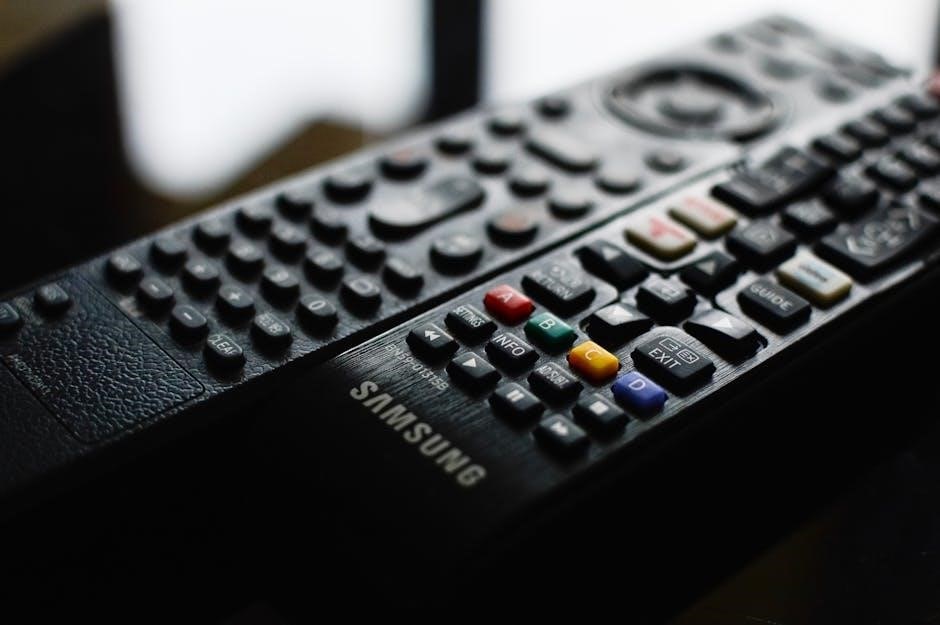
Volume +/-: Adjusts the audio level, providing convenient control from a distance.
Input: Selects the audio source (Optical, HDMI ARC, Bluetooth). An on-screen display (OSD) usually confirms the selection.
Sound Mode: Cycles through preset sound modes (Movie, Music, Direct, Dialogue) for optimized listening.
EQ Settings: Accesses equalizer presets or allows for custom sound adjustments.
Surround Sound: Enables or disables virtual surround sound processing.
Bluetooth: Initiates Bluetooth pairing with devices.
Mute: Silences the audio output instantly.
Navigation Buttons: (Up, Down, Left, Right) Used for navigating on-screen menus and settings.
OK/Select: Confirms selections within menus.
Powering On/Off and Volume Control
Powering On: Press the power button located on the sound bar itself, or use the power button on the remote control. A blue LED indicator will illuminate, signifying the unit is active.
Powering Off: Press the power button again to enter standby mode. The LED will typically turn off or change color.
Volume Adjustment: Utilize the volume up (+) and volume down (-) buttons on either the sound bar or the remote. Incremental adjustments are made with each press.
Muting: Press the mute button to instantly silence the audio. Press again to restore the previous volume level.
Auto-Standby: The S4251w-B4 features an auto-standby function, powering off after a period of inactivity to conserve energy.
Remote Range: Ensure a clear line of sight between the remote and the sound bar for optimal control;
Sound Settings & Features
Customize your audio! Explore Movie, Music, Direct, and Dialogue sound modes, plus equalizer settings for optimal Dolby Vision and HDR experiences.
Sound Modes: Movie, Music, Direct, Dialogue
Movie mode delivers immersive, cinematic sound with enhanced bass and surround effects, ideal for action-packed scenes and dramatic films. Music mode optimizes audio for a clear and balanced listening experience, highlighting vocals and instruments. For a pure, unadulterated sound, Direct mode bypasses all processing, providing the audio exactly as it was recorded.
Dialogue mode clarifies vocal frequencies, making conversations easier to understand – perfect for news broadcasts, podcasts, or movies with complex dialogue. Experiment with each mode to find the best fit for your content. These settings significantly impact your Disney+ streaming experience, particularly with Dolby Vision and HDR content, ensuring optimal audio clarity and immersion. Adjusting these modes allows for a personalized sound experience tailored to your preferences.
Equalizer Settings & Customization
Fine-tune your audio with the Vizio S4251w-B4’s equalizer settings. Access these through the sound bar’s menu or the remote control. You can adjust specific frequency bands – bass, mid-range, and treble – to personalize the sound profile. Boost the bass for impactful explosions in action movies, or enhance the treble for clearer vocals during dialogue-heavy scenes.
Custom presets allow you to save your preferred equalizer settings for different content types. Create a “Movie” preset with boosted bass, a “Music” preset with balanced frequencies, and a “Dialogue” preset emphasizing vocal clarity. This customization is crucial for optimizing your Disney+ streaming experience, ensuring the best possible audio quality for everything from Marvel blockbusters to Pixar animations. Experiment to discover your ideal sound!
Dolby Vision & HDR Compatibility (Disney+ Streaming)
Enhance your viewing with the Vizio S4251w-B4’s support for Dolby Vision and HDR (High Dynamic Range). These technologies, crucial for optimal Disney+ streaming, deliver stunning visuals with greater contrast, brightness, and color accuracy. Ensure your TV also supports Dolby Vision/HDR to fully experience these benefits.
Disney+ content, including many Marvel and Star Wars titles, is available in Dolby Vision and HDR. The sound bar automatically detects and processes these signals when connected via HDMI ARC. This results in a more immersive and lifelike picture, bringing the magic of Disney+ to life. Verify your HDMI cable is certified for HDR compatibility for the best performance. Enjoy vibrant colors and incredible detail!
Troubleshooting Common Issues
Facing problems? This section provides solutions for no sound, subwoofer connection issues, remote control malfunctions, and Disney+ error code 83 troubleshooting.
No Sound Output: Troubleshooting Steps

Initial Checks: First, ensure your TV’s volume is up and not muted. Verify the sound bar is powered on – the power indicator should be illuminated. Double-check all cable connections (Optical, HDMI ARC, or RCA) at both the sound bar and TV ends. A loose connection is a frequent cause.
Input Selection: Confirm your TV’s audio output is set to the correct input corresponding to the sound bar’s connection (e.g., Optical, ARC). Navigate to your TV’s audio settings menu.
Sound Bar Settings: Cycle through the sound bar’s input sources using the “Input” button on the remote or sound bar itself. Ensure it’s set to the appropriate input. Try different sound modes (Movie, Music, Direct, Dialogue) to rule out a mode-specific issue.
Reset & Test: As a last resort, power cycle both the TV and sound bar by unplugging them for 60 seconds, then plugging them back in. Test with a different audio source (e.g., Bluetooth) to isolate the problem.
Subwoofer Not Connecting: Solutions
Initial Pairing: Ensure the subwoofer is plugged into a working power outlet and the power switch is on. Initiate pairing mode by pressing and holding the “Subwoofer” button on the back of the sound bar for approximately 3 seconds until the subwoofer indicator blinks;
Proximity & Interference: Bring the subwoofer closer to the sound bar during the pairing process (within 10 feet). Minimize potential wireless interference from other devices like microwaves or Bluetooth speakers.
Power Cycle: Power cycle both the sound bar and subwoofer by unplugging them for 30 seconds, then plugging them back in. Repeat the pairing process after the restart.
Factory Reset (Subwoofer): If pairing consistently fails, consult the full manual for instructions on performing a factory reset on the subwoofer itself. This can resolve lingering connection issues.
Remote Control Not Working: Battery & Pairing
Battery Check: Begin by replacing the batteries in the remote with fresh, high-quality alkaline batteries. Ensure correct polarity (+/-) when installing. Low battery power is the most common cause of remote failure.
Line of Sight: Confirm there’s a clear line of sight between the remote and the sound bar’s IR sensor. Remove any obstructions that might be blocking the signal.
Pairing (If Applicable): Some Vizio remotes require pairing. Locate the “Input” or “Pairing” button on the sound bar and remote, and follow the on-screen instructions (if any) or consult the full user manual for the specific pairing sequence.
Reset Remote: Try removing the batteries from the remote for several minutes, then reinserting them. This can sometimes reset the remote’s connection; If issues persist, contact Vizio support.
Disney+ Error Code 83 & Streaming Issues
Error Code 83: If you encounter Disney+ Error Code 83, it typically indicates an account synchronization problem. First, completely close and reopen the Disney+ app on your smart TV. Ensure your TV has a stable internet connection.
App Updates: Verify the Disney+ app is updated to the latest version through your TV’s app store. Outdated apps can cause compatibility issues.

Clear Cache: Within your TV’s settings, locate the Disney+ app and clear its cache. This removes temporary files that might be causing conflicts.
Restart TV & Soundbar: Power cycle both your Vizio soundbar and your television. A full restart can resolve network and software glitches. If problems continue, check Disney’s support website for further assistance.

Advanced Features & Support
Explore further! Discover Bluetooth pairing, firmware updates, factory reset options, and comprehensive warranty details for optimal Vizio S4251w-B4 performance and support.
Bluetooth Connectivity: Pairing Devices
Pairing with Bluetooth devices is a convenient way to enjoy audio wirelessly from your smartphone, tablet, or other compatible devices. To initiate pairing, ensure your Vizio S4251w-B4 sound bar is in Bluetooth mode – typically selected via the remote control.

Next, activate Bluetooth on your source device and scan for available devices. The sound bar should appear as “Vizio S4251w-B4” in the list. Select it to begin the pairing process. You may be prompted to enter a PIN; if so, try “0000” or consult the full user manual for the correct code.
Once successfully paired, your device will connect automatically in the future when both are within range. Remember that only one Bluetooth device can be connected at a time. To disconnect, either turn off Bluetooth on your source device or use the sound bar’s remote to disconnect. Troubleshooting pairing issues may involve resetting the sound bar’s Bluetooth settings.
Firmware Updates: How to Check & Install
Keeping your Vizio S4251w-B4’s firmware up-to-date ensures optimal performance, bug fixes, and compatibility with new features. Vizio periodically releases firmware updates to improve the sound bar’s functionality. To check for updates, navigate to the “System” or “Settings” menu on your sound bar using the remote control.
Look for an option labeled “Firmware Update,” “System Update,” or similar. If an update is available, follow the on-screen prompts to download and install it. Important: Do not interrupt the update process, as this could damage the sound bar. Ensure a stable power connection throughout the update.
Alternatively, you may be able to download firmware updates from the Vizio support website and install them via USB. Refer to the full user manual for detailed instructions on USB update procedures. Regularly checking for updates is recommended to maintain the best possible user experience.
Factory Reset: When & How to Perform
A factory reset restores your Vizio S4251w-B4 sound bar to its original factory settings. This is useful for resolving persistent software issues, preparing the sound bar for sale, or clearing personalized settings. Before performing a reset, note that all custom settings, including sound modes, equalizer adjustments, and Bluetooth pairings, will be erased.
To initiate a factory reset, access the “System” or “Settings” menu using the remote control. Locate the “Reset” or “Factory Reset” option. Confirm your decision when prompted. The sound bar will power off and restart, returning to its default configuration.
Caution: Only perform a factory reset as a last resort after attempting other troubleshooting steps. Ensure you understand the consequences of erasing your personalized settings before proceeding. Refer to the complete user manual for specific menu navigation details.
Warranty Information & Customer Support Contact
Your Vizio S4251w-B4 sound bar is covered by a limited warranty against defects in materials and workmanship. The standard warranty period is one year from the date of original purchase. This warranty does not cover damage resulting from misuse, accidents, or unauthorized modifications. Please retain your proof of purchase for warranty claims.
For warranty service or customer support, visit the official Vizio website at vizio.com/support. You can find FAQs, troubleshooting guides, and contact information for their support team. Alternatively, you can reach Vizio customer support by phone at 1-800-222-6156.
Be First to Comment